

Yamaha's Redding responds to Tainton's view on domestic regulations
Yamaha Racing Team principle John Redding has shot back at Team Suzuki manager Phil Tainton's claims that a more standardised rule set in the Australian Superbike Championship would cause the "fastest bike" of that year to dominate.

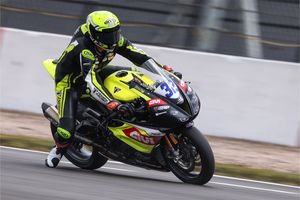
The Yamaha Racing Team and Kevin Curtain have dominated FX-Superbike racing on the YZF-R1 since 2010. Image: Keith Muir.
Yamaha Racing Team principle John Redding has shot back at Team Suzuki manager Phil Tainton’s claims that a more standardised rule set in the Australian Superbike Championship would cause the “fastest bike” of that year to dominate.
Tainton, who is also the Motorcycling Australia Road Race Commission chairman, is calling for the rules to remain as they are in ASBK 2014, believing parity is the paramount in the series’ premier category.
Click here for the complete story outlining Tainton’s thoughts and suggestions.
The Motorcycling Australia-sanctioned ASBK series competes under more highly modified regulations than the AASA-sanctioned FX-Superbike series in which Yamaha competes. YRT has long been a major supporter of a more cost-effective rule set domestically.
Redding today responded via a post on social media and further cemented his position when contacted by CycleOnline.com.au this afternoon, adamant that power isn’t everything when it comes to success on the race track.
YRT has been the dominant force since switching to the ASBK’s rival FX-Superbike series in 2010, with Kevin Curtain winning three consecutive titles on the current specification YZF-R1 – a bike recently measured to be around 30 horsepower down on BMW’s S 1000 RR in production trim.
“I disagree with the view that if the rules for Superbike were rolled back to Superstock or FX1000 specification that the BMW would automatically win in anyone’s hands as it is the most powerful of the current 1000cc sportsbikes,” Redding wrote.
“If the article specifically targets Glenn Allerton and his team, perhaps they are putting in the biggest effort currently and would achieve their results regardless of the brand of bike they were supported by?”
Curtain and his YRT teammates over the past few seasons have been consistently at the front of FX fields on a variety of circuits, most notably challenging dual ASBK champion and 2013 series leader Allerton during two appearances at Sydney Motorsport Park last year.
Since the opening FX round last season, Allerton has contested a number of FX events in both the FX and Formula Oz categories, amassing an exceptional record of 31 straight victories between the two classes (13 in FX-Superbike and 18 in Formula Oz).
In his most recent FX-Superbike class outing at Sydney Motorsport Park during 2012’s finale, Allerton claimed pole position by 0.324s, won the first seven-lap affair by 0.868s, the second by 2.308s and the third by 0.480s.
Still, Redding is certain that there are more factors other than horsepower amounting to Allerton and others’ success in the category.
“Anyone who follows the FX series knows that bikes are routinely dynoed in make/model groups to ensure all are playing fairly by the rules,” Redding added. “The R1, for example, is consistently one of the least powerful of all the 1000cc bikes on the FX dyno read outs.
“According to this article’s views, the R1 should never be able to challenge a BMW or Kawasaki when in this relatively standard (FX1000) spec. I think Kevin Curtain, Rick Olson, Pat Medcalf and Broc Parkes’ results in the FX1000 class over the last few years bely this view.
“People would argue these riders are at the top of their game, but that takes away from champions like Glenn Allerton and Matt Walters, just to name a couple who have and do race against them. While horsepower is important, for sure, making a race winning package involves the rider and the team making a motorcycle that does everything well.”
And while a factory team focused on winning races full time will always benefit, Redding outlined the capabilities of privateers under the stock format for FX-Superbike competition.
“A factory team is professionally focused on achieving this aim [of creating the full package], hence, regardless of the rules, these teams are nearly always at the top,” Redding continued.
“I believe that if all the factory teams raced together in the same series under the same FX1000/Superstock rules, the racing would be closer than currently in ASBK, not only because the factory teams would work hard to provide their riders with the best packages, but because the privateers would have a better chance to run closer to the factory riders.
“Giving privateers a better opportunity to race on fairly equal machinery that doesn’t cost the earth must surely be a benefit to growing the fields and growing the sport.”
Recent